About:

About:
Established in 1982 at LaGuardia Community College/ CUNY with a mission to collect, preserve, and make available primary materials documenting the social and political history of New York City. We hold nearly 5,000 cubic feet of archival records and 3,200 reels of microfilm with almost 100,000 photographs and 2,000,000 documents available on our website.
Showing posts with label New York City. Show all posts

Friday, April 15, 2016

Steinway Hall: A Place for the Piano in Music, Craft, Commerce and Technology

"There’s a separate world inside 109 West 57th Street, and it has nothing and everything to do with the world outside.  Everything because it’s a house of music, and music connects to all people…and all things….  And nothing, because – well, because it’s a world of pianos. The name of the place is Steinway Hall." – Kyle Kevorkian, “The House of Steinway,” 1992

Steinway Hall, W 57th St., c.1925
Earlier this week, Steinway & Sons opened a new Steinway Hall, the third in the history of the city.  But what is Steinway Hall?  Is it a concert venue?  A piano showroom?  An intimate home for artists and music lovers?  The corporate presence of Steinway and Sons in the cultural heart of America?

Steinway Hall, E.14th St., 1860s
Since 1866 when the first Steinway Hall opened on East 14th Street, Steinway Hall has stood uniquely as a nexus of music, craftsmanship, commerce, technology and the cultural life of New York City.

When William Steinway agreed to let the Women’s Suffrage Association use Steinway Hall in 1871 (the subject of last month’s Blog post for Women’s History Month), he not only rented his hall (the second largest in the city) for a major civic meeting, he also knew it was an opportunity to advertise pianos.

Wednesday, December 30, 2015

Letters to Mayor Lindsay: Children Respond to the 1966 New York City Transit Strike

Children from all over New York City, and around the country wrote to Mayor Lindsay during his first year in office.  The new mayor was, after all, a highly visible man, a strikingly tall and energetic figure.  Many simply asked for a picture or autograph.  But more than any other subject, children wrote to the mayor about the 12 day transit strike, the worst in the city’s history.  Many witnessed it in their daily lives.  Others saw it on television.  Some talked about it in classrooms as far away as Massachusetts.  Here is a selection of their letters.

Excerpt of Child's Letter to Mayor Lindsay - Courtesy NYC Municipal Archives
On January 1, 1966, as John V. Lindsay took the oath of office as New York City’s 103rd mayor, transit workers all over the city, led by Mike Quill, walked off the job.  Our video about the 1966 transit strike uses contemporary newsreel footage to explore the strike through the experience of adults: the mayor and commuters walking to work; long lines; and crowded highways.  Children’s letters to the mayor offer a different perspective.

Tuesday, September 16, 2014

The Roosevelts and Fiorello La Guardia


As La Guardia looks on, President Roosevelt  
signs proclamation naming December 15 as
‘Bill of Rights  Day’ at the White House, 1941

For more photos click here and here


At rally to fight for enactment of Fair Employment Practices Act, La Guardia speaks with FEP committee co-chairman A. Philip Randolph and Eleanor Roosevelt, 1946


Steven A. Levine
Coordinator for Educational Programs

This past Sunday, PBS began airing “The Roosevelts: An Intimate History,” Ken Burns’s documentary about the lives of Theodore, Franklin, and Eleanor Roosevelt.  In 1934 FDR gained a great ally when Fiorello La Guardia became mayor of New York City.  La Guardia defeated Tammany Hall and brought clean and efficient government to NYC, while successfully creating a direct relationship to the White House to fund New Deal projects.  La Guardia, the son of immigrants, came from a humble background, while Eleanor and Franklin descended from one of America’s oldest families.  They nevertheless developed close political friendships, based on shared goals. Under La Guardia’s leadership, New York City used New Deal funds to employ hundreds of thousands to build highways, subways, schools, hospitals, parks, housing and other infrastructure. 
The importance of the relationship between La Guardia and Franklin and Eleanor can be found in the La Guardia and Wagner Archives’ collection, containing 16 photos of Eleanor and 20 photos of Franklin.  If you would like to learn more about La Guardia, the Roosevelts and the New Deal, please feel free to contact me


President Roosevelt, Governor Lehman, and Mayor La Guardia campaign together in the 1940 election   campaign.


La Guardia,head of joint U.S.-Canada Defense Board, meets with President Roosevelt and military brass at the White House, 1940          


La Guardia, union leader Sidney Hillman,and Eleanor Roosevelt talking at a dinner honoring Eleanor at the Hotel Commodore, 1941


La Guardia and FDR at the annual Roosevelt Picnic at Hyde Park, NY, 1938 


Thursday, August 21, 2014

Mayor Lindsay Walks the Streets of Harlem


Steven A. Levine
Coordinator for Educational Programs

On April 4, 1968, a nation wounded both by the Vietnam War and the divisions it had created, and by outbreaks of civil unrest in its cities, faced the assassination of the Reverend Martin Luther King, Jr.  Pent-up anger and frustration in the African-American community led to rioting, looting and arson that destroyed vast swaths of neighborhoods in Washington, DC, Chicago, Kansas City, Newark and Baltimore.  In New York City, it was a different story.  Because Mayor John Lindsay and his staff had built relationships with the African-American community, Lindsay was able to travel to Harlem after the assassination and help calm an angry crowd, greatly limiting the damage done.  To learn more about the night of April 4 in Harlem, see the video interview with Lindsay aide, Sid Davidoff.
            Unfortunately, little has been learned from 1968 as can be seen from the horrifying events surrounding the killing of Michael Brown, an unarmed, young black man in the St. Louis suburb of Ferguson, Missouri. This and the events that followed have brought systemic American racism to the forefront.  While there are many causes for the racism that led up to Michael Brown’s death, one of them was a lack of communication between the predominantly white local government police force and the African-American community.  Lindsay intuitively understood the importance of building these relationships, something that has been forgotten as American police departments have become increasingly militarized.

Monday, May 12, 2014

NYC Transit Strike, 1966


On January 1, 1966, New York City, dependent upon mass transit as no other city in America, awoke to a daunting problem -- a complete subway and bus shutdown. For Michael Quill, 60-year-old president of the 32,600 members of the Transport Workers Union and native of County Kerry, Ireland, it was contempt at first sight when he set eyes upon newly-sworn Mayor John V. Lindsay, 44-years-old and Yale educated. The strike had heavy consequences, costing Quill his life and halting the city's transit lifeline for 12 days. This video, from a Universal newsreel, shows the city as never before.

Wednesday, April 9, 2014

First 100 Days of Mayor Ed Koch : Was I naive?


Steven A. Levine
Coordinator for Educational Programs

The first 100 days of an NYC mayor can be very difficult. Mayor de Blasio reached his first 100 days this week. In 1978, Mayor Ed Koch did an interview in which he admitted to being naive when he took office and he confronted NYC's fiscal crisis after his first 100 days.

Monday, October 21, 2013

Alair Townsend Debates Ed Koch: "She had the better book!"


Steven A. Levine
Coordinator for Educational Programs

As we approach tomorrow night's mayoral debate at the CUNY Graduate Center, I thought it was a good time to look at how other candidates prepared for a debate by watching a video of Deputy Mayor Alair Townsend describe her experiences as Mayor Ed Koch's practice debate partner in 1985.
 

To prepare for his debate against City Council President Carol Bellamy, his Democratic Primary opponent, Ed Koch chose Townsend. Townsend claimed she was chosen because she had glasses and high cheek bones like Bellamy, but it is also clear she was a more than worthy debate opponent.  When his campaign adviser David Garth told Koch that Townsend had beat him after the first mock debate, Ed Koch responded by saying, "She had the better [debate] book!"  Watch Alair Townsend describe the debate, her preparation and the debate book in this interview with the La Guardia and Wagner Archives' Tara Jean Hickman.


Wednesday, October 16, 2013

Fiorello La Guardia Takes a Sledge Hammer to Slot Machines: Let's Go to the VIDEO!


Steven A. Levine
Coordinator for Educational Programs

When Fiorello La Guardia became mayor of NYC in 1934, organized crime and gambling racketeers were his particular bugbears and he went on campaigns to wipe them out. During Prohibition in the 1920s, organized crime had spread from liquor to gambling, narcotics, and the “service of outlawed desires.” One of La Guardia’s earliest public acts as mayor, shown on the following video, was to swing his hammer to smash slot machines and ceremoniously dump them in the Long Island Sound on October 13, 1934.


In the 79 years since Fiorello smashed and dumped those slot machines, a sea change in government’s relationship with gambling has occurred as racetracks, like Aqueduct and Yonkers, have become “racinos” filled with the slot machines La Guardia loathed because he believed they took money from families that should go to feed their children.  New York State voters will also be voting on November 5 on whether to approve a constitutional amendment, backed by an alliance of gambling interests, Indian tribes, and Governor Andrew Cuomo, to allow casinos to open in the Catskills, the Southern Tier and the Albany area.   The New York Times reported yesterday that the gambling industry has spent “more than $59 million on lobbying and political contributions in New York” since 2005.  We know that they are betting a big return on their investment.  I am sure if La Guardia were here today he would be shouting to the rooftops against it.   What do you think?

Friday, September 20, 2013

Ed Koch for Mayor 1985 Campaign Commercials


Steven A. Levine
Coordinator for Educational Programs
 
When Ed Koch ran for a third term as mayor in 1985, he won handily against a divided opposition, but what is striking to me was the lack of polish in his commercials.  The endorsements by the "regular people" seem unrehearsed and Mayor Koch does not even appear in them.  The commercials seem to emphasize that whatever the critics might say, the people still supported Koch.  They raise the question of whether the supporters were given lines to read or were they expressing their support sincerely?  With the exception of actor Vincent Gardenia's endorsement, they seem more coarsely produced than those of today.  Media wizard David Garth effectively demonstrated Koch's support by the common man and woman.  The election results that year confirmed this perception. Take a few minutes to watch the video to see what you think.

Tuesday, September 3, 2013

1977 Ed Koch Campaign Commercials


Steven A. Levine
Coordinator for Educational Programs

With the New York City mayoral primaries a week away, I thought it would be interesting to look back at the 1977 mayoral election and how Ed Koch’s campaign commercials helped lead him to victory.  This was a bleak year for New York City, which was teetering on the edge of bankruptcy and could not borrow money on its own credit.  Thousands of police officers, firefighters, teachers, CUNY faculty and other municipal workers had been laid off.   A blackout had led to mass looting in many neighborhoods, Son of Sam was wreaking his terror upon the city, and crime in general was on the rise. 
As the election season began, Congressman Koch was polling at the bottom of a large group of Democratic candidates that included Mayor Abe Beame, former Congresswoman Bella Abzug, N.Y. Secretary of State Mario Cuomo, Congressman Herman Badillo, and Manhattan Borough President Percy Sutton.  Running as a “liberal with sanity,” Koch endorsed the death penalty, attacked the municipal unions and their leaders, and  “poverty pimps.”  Koch ended his advertisements, crafted by campaign manager David Garth with the tagline, “After eight years of charisma [John Lindsay] and four years of the clubhouse [Abe Beame], why not try competence.” 
With his conservative message, Koch catapulted to second place in the primary.  He then defeated Mario Cuomo in the runoff and the general election, when Cuomo ran as the candidate of the Liberal Party.  In a city where crime appeared out of control, municipal unions were striking, and the fiscal outlook was bleak, Koch had sensed that a more conservative candidate would appeal to a large portion of the electorate.  His election was a watershed and ushered in years of austerity and a more limited view of what government could or should do.
The dominant issues in this year’s Democratic primary are very different as the Bloomberg era comes to a close.  Crime is at a historic low, but the stop and frisk policies of the NYPD have come under fierce criticism.  The shimmering towers that have risen in Manhattan and on the waterfronts of Queens and Brooklyn are symbols of both increasing prosperity and the rising inequality of New York City.  Whether these themes augur a new watershed for New York’s politics remains to be seen until after primary day and beyond when future historians analyze the campaign advertisements of 2013.
P.S.  To learn more about voting in New York City, check out the Archives’ curriculum, “City Government and You:  Voting Rights and Citizenship.”

Thursday, January 24, 2013

VIDEO: Women in the World War II Military

                                                                           WAVES Visiting USS Missouri, 1944
      National Archives


Steven A. Levine
Coordinator for Educational Programs

With Defense Secretary Leon Panetta’s announcement that the Pentagon will lift the ban on women serving in combat, it seemed an opportune moment to watch the La Guardia and Wagner Archives’ video on the WAVES (Women Accepted for Volunteer Emergency Service), a branch of the Navy during World War II. The WAVES were the first women to serve in the Navy beyond traditional roles as secretaries and nurses and many of them trained at Hunter College in the Bronx (now Lehman College). Despite their limited roles, which included detasseling corn in Iowa, the women of the WAVES (and their Army and Air Corps counterparts in the WACs and WASPs) played a crucial role in the victory during World War II and opened the doors for women in the military in the future.
To learn more about women and their role in the military and on the home front during World War II, check out the New-York Historical Society’s exhibit WWII & NYC, the Archives’ lesson Women and World II, and a website on the WAVES created by the US Military.
P.S. If you would like to see more Archives materials, check out our Facebook page and Like us.

Friday, December 7, 2012

Triangle Shirtwaist Fire, New York 1911 and Tazreen Fashions Fire, Bangladesh 2012: When will we ever learn?

Steven A. Levine 
Coordinator for Educational Programs


Triangle Shirtwaist Fire New York 1911

            When we shop for clothing, price is often paramount in our considerations and we too often neglect to ask who makes our clothing and what are their wages and work conditions, until these conditions become deadly and appear on the front pages of our newspapers.  I could be referring to last month’s factory fire in Bangladesh, but the “high cost of low prices” has a long history and the parallels between the 1911 Triangle Shirtwaist Fire in New York and the fire  at the Tazreen Fashions factory in Bangladesh are eerily similar.  (To learn more about the Triangle Shirtwaist Fire, check out the memorial created by State Senator Serphin Maltese, who lost family members in the fire. For more information on the Tazreen Fashions factory fire go to “Fatal Fire in Bangladesh Highlights the Dangers Facing Garment Workers” “Garment Workers Stage Angry Protest After Bangladesh Fire” and “Horrific Fire Revealed a Gap in Safety for Global Brands.”)

            Both factories paid low wages to a predominantly female work force. In the early 20th century, New York was the center of the garment industry and Bangladesh today exports $18 billion in clothing, second only to China.  Triangle sold blouses to the major department stores; Tazreen produced clothing for Wal-Mart and other global retailers.  The New York Times coverage of the two fires sadly makes clear that workers in both factories had similar deaths because of unsafe conditions.
Witnesses described a desperate scene, as workers leapt from the upper floors of the factory, trying to land on nearby rooftops and escape the smoke and flames. Others suffocated inside the factory building, as the blaze apparently rendered stairwells impassable.  .  .  “These international, Western brands have a lot of responsibility for these fire issues,” said Ms. Akter, the executive director of the Bangladesh Center for Worker Solidarity. “In this factory, there was a pile of fabrics and yarn stored on the ground floor that caught fire. Workers couldn’t evacuate through the stairs. What does this say about compliance?
The New York Times, November 26, 2012, “Garment Workers Stage Angry Protest After Bangladesh Fire”

Most of the victims were suffocated or burned to death within the building but some who fought their way to the windows and leaped met death as surely, but perhaps more quickly, on the pavements below.  . . .  The one little fire escape was never resorted to by any of the doomed victims.  Some of them escaped by running down the stairs, but in a moment or two this avenue was cut off by flame.  The girls rushed to the window and looked down at Greene Street, 100 feet below them.  Then one poor, little creature jumped.  There was a plate glass protection over part of the sidewalk, but she crashed through it, wrecking it and breaking her body into a thousand pieces.  Then they all began to drop . . .
The New York Times, March, 26, 1911, “141 MEN AND GIRLS DIE IN WAIST FACTORY FIRE; TRAPPED HIGH UP IN WASHINGTON PLACE BUILDING; STREET STREWN WITH BODIES; PILES OF DEAD INSIDE.”

            The Triangle Shirtwaist fire led to the creation of the Factory Investigating Commission led by Senator Robert F. Wagner (Chair), Assemblyman Alfred E. Smith (Vice- Chair), along with a reinvigorated movement to protect workers and improve factory conditions and the enactment of 25 New York State laws to implement the Commission’s recommendations.
  
            After the deadly fire in Bangladesh, thousands of protesters took to the streets to demand justice.  The horrific fire there, like the one a century earlier, makes clear that workers cannot achieve justice without the right to organize unions and employers and the global corporations whom they sell to must respect the rights and lives of their workers above that of their profits now stained by the deaths of 112 workers. As we shop for clothing, we must also think about the consequences of our consumption.

Monday, November 19, 2012

Public Housing Discussion on Brian Lehrer's CUNY TV progam

Archives staff Tara Hickman and Steven Levine and public housing historian Nicholas Bloom discuss the history of NYC public housing and how the Archives uses the NYCHA collection in teaching at LaGuardia Community College on Brian Lehrer.TV.  Check it out on You Tube.  The public housing segment begins at minute 31.


Friday, October 19, 2012

Happy Birthday Eleanor Roosevelt, October 11, 1884

First Lady Eleanor Roosevelt and Mayor Robert F. Wagner, 1956
Steven A. Levine
Coordinator for Educational Programs
In 1963, a year after Eleanor Roosevelt’s death, Mayor Robert F. Wagner memorialized her at the National Roosevelt Day Dinner of the Americans for Democratic Action, the liberal organization she co-founded in the late 1940s. Click here to read Mayor Wagner's speech.
Wagner's relationship with President Roosevelt and First Lady Eleanor Roosevelt was closer than the ones he had with most New York politicians. His father, Senator Robert F. Wagner was a close confidant of the president, going back to their days in the New York State Legislature and the young Wagner knew the future president and first lady from his childhood. But in his years as mayor, Eleanor Roosevelt became both critic and adviser to him. “She instructed me, she criticized me, both publicly and privately. On more than one occasion, she censured me, to my profit, I might add. . . . She was more than a great lady, more than a great personality, more than a great humanitarian. She was a great phenomenon in a phenomenal age.”


If you want to learn more about Eleanor Roosevelt or use other Roosevelt related materials in your classroom, please contact me or Tara Jean Hickman
thickman@lagcc.cuny.edu at the Archives.

Tuesday, July 3, 2012

"I Am An American Day" 1941 and 1945


Steven A. Levine 
Coordinator for Educational Programs


In celebration of Independence Day, I hope you will take the time to watch the Archives’ YouTube video “I Am An American Day: 1941 and 1945” and consider the meaning of U.S. citizenship today and also what it meant to Americans during World War II. In 1940 Congress created “I Am An American Day” to honor Americans who had reached voting age and immigrants who had become citizens. The event in Central Park in 1945, as World War II came to a close, attracted more than one million people.


Thursday, January 12, 2012

Civil Rights in New York City: In Honor of Dr. Martin Luther King, Jr.

Steven A. Levine
Coordinator for Educational Programs

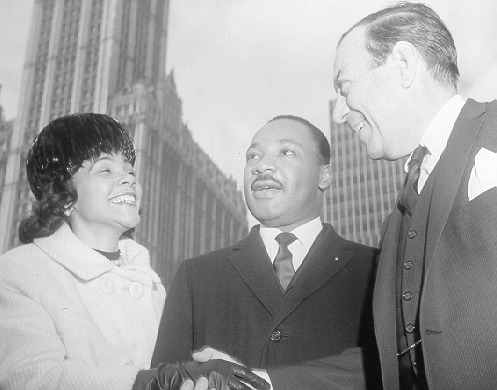
Dr. Martin Luther King and Coretta Scott are welcomed by Robert F. Wagner at City Hall upon King's return to the U.S. after receiving the Nobel Peace Prize, December 18, 1964. 

Dear Friends and Colleagues,

In the spring of 1963, Birmingham, Alabama was the focal point of the civil rights movement.  Mass demonstrations, sit-ins and protests led to the arrest of hundreds, including Dr. Martin Luther King, Jr., by the brutal police force of Commissioner of Public Safety Eugene "Bull" Connor. 

            With the nation's attention focused on Birmingham, New York's Fur and Leather and Machine Workers Union organized a Rally for Equality on May 28th, 1963 to support the civil rights struggles in the South.  Scheduled to speak at the event was Mayor Robert F. Wagner. What was striking about his speech was not Wagner's support for the freedom struggle in the South, but for its focus on civil rights in New York City.  He declared "If all we are going to do for the freedom fighters of the South is to express our sympathy for them, that might be helpful, but it wouldn't be enough.  It might even be considered a little hypocritical?" 

He used the rally to recommit his administration to fighting discrimination in New York City, issuing an executive memorandum directing all city agencies and departments "to review and re-assess all their present programs and activities pertaining to equal rights and opportunities for all" with the goal of expanding them or launching new ones.  Wagner was sincere, but he was also responding to a growing civil rights movement organizing to desegregate housing and public schools, end discrimination in employment, and empower New York's growing African-American and Latino populations.

Wagner's speech was a harbinger for the increasing polarization of New York City on racial issues.  Even as he gave his speech, his office had created a folder for "hate mail" from people opposed to his civil rights initiatives and his support for the movement in the South. (Sample) Simultaneously, the slow pace of change was leading to greater anger and impatience in the African-American community.  A year later, the NYPD would be putting down an uprising/riot in the streets of Harlem and Bedford-Stuyvesant, after an off-duty police officer shot and killed an unarmed African-American high school student.